











As a mom in Florida (send thoughts & prayers), my group chats have been absolute chaos since September 3, when state officials announced they’re ending vaccine mandates for kids in school and childcare. One friend sent me the headline with ten screaming emojis, another said she was considering homeschooling, and I was busy panic-Googling “can vaccinated toddlers still get measles?” at midnight. Not a calming activity.
I was born here. I was raised here. (I moved away post-grad, but came back for the same reason anyone moves back to their home state: my parents are here, and no way in hell was I raising kids without perpetual babysitters less than a two-hour drive away.) However, politically, emotionally, and humidity-tolerability-wise, I do not belong here. But unless my 60+-year-old parents move, then well? I’m going to be here too.
Which brings us back to early September 2025, when I felt like we were starring in the newest season of American Horror Story. No matter how much I researched, I didn’t feel any more reassured. The opposite, in fact. Experts are warning about outbreaks. Politicians are talking about “parental freedom.” And meanwhile, parents like me are stuck in the middle trying to figure out what this means for our actual kids — you know, the ones still licking playground equipment and coughing directly into each other’s mouths — and the ones we were thinking of having down the line.
That’s why I tapped the experts to really break it down for us. What exactly did Florida just do? Which vaccines are still required (and which aren’t)? How worried should parents really be? And most importantly: what the hell can we do about it?
What TF Is Going On With The Florida Vaccine Mandates
Recap: On September 3, Florida’s Surgeon General Joseph Ladapo — with Gov. Ron DeSantis nodding along — announced that the state will move towards ending school vaccine mandates. Translation: starting in about 90 days (so, early December 2025), kids will no longer need proof of certain shots to enroll in school or childcare.
Which ones got the axe? Hepatitis B, Hib (Haemophilus influenzae type b), chickenpox, and pneumococcal vaccines are off the list. The vaccines for measles, mumps, rubella, polio, diphtheria, pertussis, and tetanus are still required… at least for now. Those can only be removed by the legislature, which won’t reconvene until 2026, but Florida’s current plan is to nix those ones as well.
This means Florida will officially become the first state to end the vaccine mandates for school and childcare. “This matters because mandates are powerful motivators to follow a public health intervention,” Alok Patel, MD, Clinical Assistant Professor at Stanford Medicine and Stanford Children’s Health, says. “They may be boring and at times unpopular, but they save lives. Look at the rules and regulations surrounding car seats, seat belts, helmets, lifejackets, and traffic lights. They may not prevent all accidents, but they undoubtedly save lives.”
Pediatric critical care physician Anita Patel, MD clarifies: “This does not mean that Florida is specifically discouraging children from being vaccinated, but rather they will not be requiring them for enrollment in school, which previously was the standard for admission to any publicly funded (and most privately funded) schools in the United States.” This is where the whole “parental freedom” stuff comes into the mix, but more on that in a sec.
Essentially, before now, kiddos had to have proof of vaccines to go to school. Now? They won’t.
What Does This Mean For Kids?
The short story is that, without mandates, the decision to vaccinate is left entirely up to parents. And while that might sound like freedom, it also means the safety net schools once provided disappears.
“Vaccines protect more than the individual; they’re a community protection tool,” explains Dr. Alok Patel. “If viruses and bacteria have fewer people to infect, they don’t spread. This is how smallpox was eliminated and why certain vaccine-preventable diseases are so rare now. Know any kids in America with polio? Me neither. You can thank vaccines for that.”
The diseases that no longer require vaccines aren’t small stuff. Before the chickenpox vaccine, the U.S. saw millions of cases every year with thousands of hospitalizations. Hib used to cause meningitis and epiglottitis — life-threatening conditions in young children. Hepatitis B can cause chronic liver disease and cancer. “Fast forward to modern times, I’ve never seen a case of Hib — all because of vaccines,” Dr. Alok Patel says. “Why would we want to risk reversing these trends?”
Dr. Anita Patel points out that the people most at risk are the ones with the least choice. “Children less than two months old can’t receive their first round of vaccines for illnesses such as pertussis or influenza. I’ve cared for infants with both, and they often require ICU ventilators. In some cases, they don’t survive.”
The takeaway? Even if your own child is vaccinated, lowering the bar for everyone else means babies, kids with weakened immune systems, and even grandparents (AKA our parents) are more vulnerable. And ahem — as someone whose dad ended up with a collapsed lung as a result of RSV, it’s not something you want to fuck around with.
What Does This Mean For Society?
It’s easy to think about vaccines as a ~me and my kid~ decision, but the impact goes wayyy beyond the carpool line. Mandates weren’t just red tape — they were a way to make sure all kids, regardless of background or access, were protected. Without them, those protections can start to fray.
“Without mandates, the easiest path for some families may simply be to forgo shots,” explains Dr. Alok Patel. “For families with insurance barriers or other obstacles to care, they may also just skip vaccines entirely.” Think about it: When’s the last time you skipped a dental check or eye exam? But if you need to get labs done for insurance coverage? Yeah, you’ll be heading your ass to Quest.
And tbh, this all adds up. Florida already sits at about 89% of kids fully vaccinated by kindergarten — a number experts say is too low for herd immunity against certain diseases. If it dips further, outbreaks of illnesses like measles, whooping cough, or chickenpox aren’t just possible — they’re likely.
And the ripple effects aren’t just medical. Dr. Alok Patel notes that vaccines have saved $540 billion in direct healthcare costs and $2.7 trillion in indirect costs for kids born between 1994 and 2023. Fewer vaccines means more sick kids, more parents missing work, more hospital bills, and a bigger strain on the economy. And you know what else is in Florida besides old people and men in flip-flops? Disney World and Universal — giant tourism engines the state depends on. The last thing Mickey or Harry Potter needs is a measles outbreak shutting down family vacations (good luck convincing tourists to ride Space Mountain mid–whooping cough outbreak).
Then there’s the bigger “what if.” Right now, Florida has only rolled back certain vaccines. But if the legislature ever goes further — cutting requirements for heavy hitters like measles or polio — the consequences would be devastating. “I shudder to think what could happen if we gave polio a second chance to cause disability here in the U.S.,” Dr. Alok Patel says. “These diseases that used to run rampant caused a lot of death, but even more lifelong disabilities. Rejecting vaccines and removing mandates is the antithesis of prevention and protecting children.”
Dr. Anita Patel adds that choices like this erode public trust. “Decisions not based on evidence sow further mistrust. Vaccine mandates ensured that children, regardless of background, were protected from preventable illnesses. Removing that protection doesn’t just affect kids — it affects entire communities.”
Or, as Dr. Alok Patel points out, vaccine mandates aren’t some new overreach — they’re literally part of America’s foundation. “Oftentimes, I’ll run into an antivaccine activist or someone who vehemently denounces mandates on social media who uses terms such as ‘freedom’ and ‘patriot’ to defend their stance. Nonetheless, vaccine mandates are as old as our grand country,” he says. “George Washington, the original patriot who helped give us a reason to celebrate freedom, mandated that his army get the smallpox vaccine. Many of our forefathers were pro-vaccine and saw the community net benefit. George Washington once said smallpox was deadlier than the sword of the enemy.”
What Can Parents Do?
Okay, so if you’re a parent in Florida (hi, it’s me), this is the part where you’re probably wondering: do I panic-pack the minivan and move to the Northeast and pretend leaf-peeping is a personality trait? Short answer: No, but it’s complicated. Long answer:
First, make sure your kids are fully up to date on their vaccines — regardless of what the state requires. “All parents should be engaged in the discussion, ask all the necessary questions, and stay skeptical about the various online outlets and ‘wellness influencers’ spreading hot takes on vaccines,” says Dr. Alok Patel. “Then, I would make sure your children are up to date on all their shots. Encourage your friends and family to do the same. Remember: your decisions directly affect those around you.”
Dr. Anita Patel agrees, noting that while fear is a valid feeling right now, it won’t exactly help us. Instead, parents should keep following guidance from trusted medical groups like the American Academy of Pediatrics. “The evidence is clear; routine vaccinations save lives,” she says.
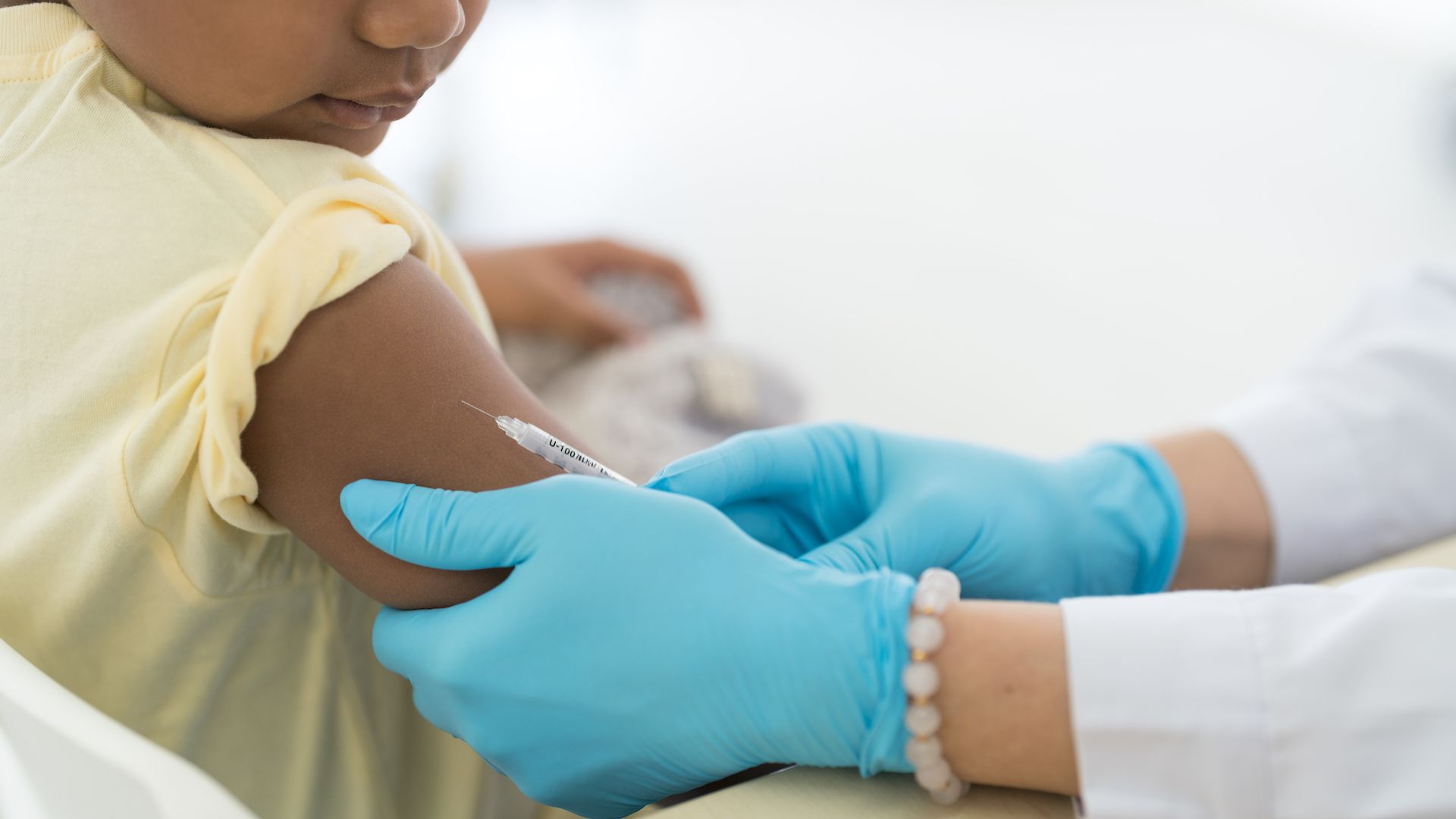
But let’s be real — for parents living here, this feels personal. When I asked my pediatrician what this change really means, she told me point-blank: “Kids will die.” Hearing that as my daughter got her nine-month shots (including Hepatitis B, one of the ones Florida just dropped) a week after the announcement was… jarring.
And I’m not the only one shaken. One Florida mom told me, “I’m so sick and tired of basic science being politicized at the expense of innocent lives.” Another mom, who is a registered independent voter, says she’s scared to think of what the world will look like for our kids. A Republican friend and mom of three told me this decision feels like a betrayal to her family.
Of course, not every parent sees the rollback as a bad thing. One IG commenter on a Washington Post story wrote, “This is finally giving families the freedom to choose without government control.” Another said, “I’m not anti-vax, but I am pro-parent choice. This feels like a win.”
But experts stress that what sounds like freedom on paper can come with real risks in practice. “Children congregate in schools, leading to perfect conditions for infections to rapidly spread not only to students, but their families,” says Dr. Anita Patel. And if something isn’t required, is a parent — who has limited time, money, and resources — more likely to take the time to research and make an informed, scientifically-backed decision, or will they just… not make an appointment to get their kid shots since it’s “not required”? Not a hard riddle, fam.
So… the big question is: Should we just fucking move? Dr. Anita Patel admits that if you have an immunocompromised child and the means, relocating isn’t the worst idea — but that’s a luxury option most families don’t have. Dr. Alok Patel puts it bluntly: doctors can’t tell you to move, but they can urge you to protect your kids, keep them on schedule, and encourage others to do the same.
And beyond your own household, the experts emphasize speaking up. Call your pediatrician. Talk to your school. And yes, blow up your reps’ inboxes. Policies like this don’t change unless parents make noise — and moms are really, really good at making noise.
One option that came up again and again: getting certain vaccines early. “If you have a child at least six months old, talk to your physician about getting their first MMR shot early,” says Dr. Anita Patel. “The vaccine is highly effective, and if you give the first dose before a year, your child will still need a second at 12 months — but they don’t need an extra shot overall.” My own pediatrician — the doctor who’s been seeing both my kids since birth — reiterated this point. With measles cases climbing nationwide, she told me she’d rather see kids protected early than left vulnerable.
Which brings us back to the hardest pill to swallow: vaccines have worked so well that some people have forgotten what life was like without them. As Dr. Alok Patel says, “The bittersweet success of vaccines lies in the fact that many parents have never heard of the disease they prevent – they aren’t afraid of them. That’s privilege, that’s a testament to the power of vaccines, and that’s a reality that we owe to our children to protect and defend.”